Hello, and a very Happy New Year!
The holidays were indeed very nice. We had a family trip to watch the excellent Arthur Christmas (2011), which I’m proud to say involved very little wriggling about from even the youngest of our party (her first proper cinema experience at that) and, what’s more spectacular still, not one toilet break (impressive on everyone’s behalf – it was very cold outside).
There were also a lot of classic films on TV over the break. I wonder how many households up and down these fair isles had similar conversations:
“It’s rubbish… just a succession of increasingly misogynistic vignettes… The only good bit is when she finds the CD and does all of the film’s acting… I saw a TikTok where they mashed that bit up and cut to him falling off the top of the building, like she’d pushed him… How can that be a spoiler??? It came out in 1988… What do you mean, you’ve never seen it?…Yes, it IS a Christmas movie. I don’t care what HE said, it’s set in an office Christmas party…No, that’s LA, that’s set in Chicago… You haven’t seen that either?… Bits of it don’t count! … No, obviously it would all be different now, you’d just phone up the neighbours and WhatsApp him… Yes, but not as painful as stepping on a Lego brick…No, that’s the second one, in a hotel lobby, for about 5 seconds… No, he doesn’t spoil it…”
“I can’t believe this – seriously, what have you been doing?…It’s always on! Yes, based on a short story. No, not scary, just very grim… No, it’s excellent but very long…no, not that long… yes… I can’t tell you, it will ruin it… Just keep watching… I can’t believe I’m going to have to sit through this again…”
But I’m not infallible readers, I’ve still never seen The Bridge On The River Kwai (1957)…
But now that the mince pies have been replaced by Easter eggs on the shelves of every reputable supermarket, it’s time, once more, to dust off the laptop and return for the next thrilling instalment of View From Tlhe Helm! (Da da daaa!)
The Blue Caftan
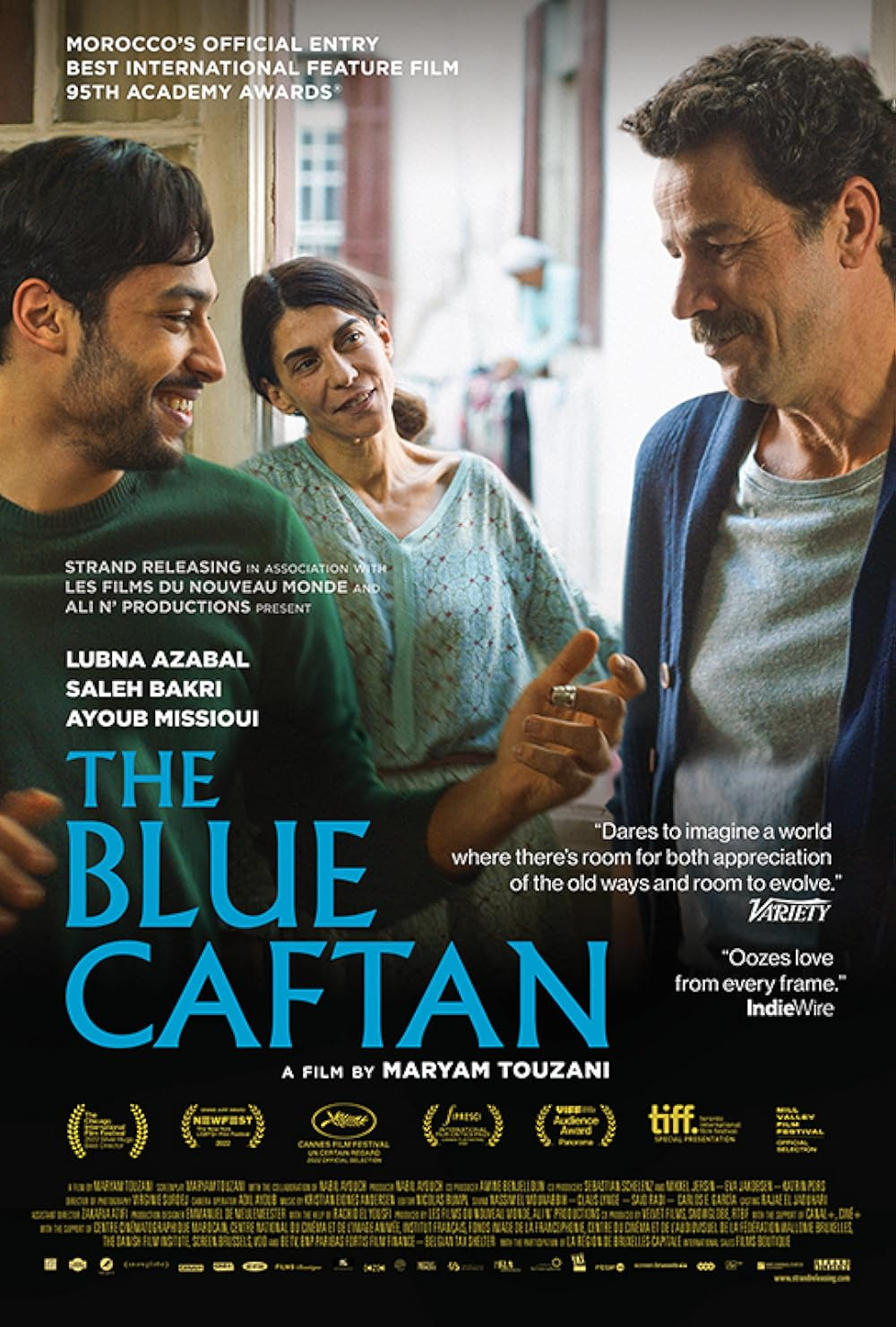
The first offering from Chiltern Film Society in 2024 is the Moroccan romantic drama, The Blue Caftan (2022), showing at The Elgiva on Wednesday 10th January.
Directed by Maryam Touzani, who co-wrote the screenplay with Nabil Ayouch, The Blue Caftan tells the story of Mina (played by Lubna Azabal) and Halim (Saleh Bakri), a married couple who craft and sell traditional garments in a medina in Sale, Morocco.
Halim is a closeted gay man and Mina is accepting of this – the pair have built a loving marriage and successful partnership over their years together. Events take an unexpected turn when Youssef (Ayoub Missioui) is hired to help keep up with customer demand. Halim and Youssef have a strong attraction to each other and the three characters must find a way to navigate this and shape their futures.
The Blue Caftan received much critical acclaim and was nominated for prizes at the Tromso, Marrakesh and Palm Springs International Film Festivals, winning the Un Certain Regard FIPRESCI prize at Cannes.
Come and see what you think on Wednesday, if it’s only to get some tips on your needle point.

Somewhere over the rainbow
Reds (1981), Orange County (2002), Old Yeller (1951), The Fried Green Card Mile, Blue is the Warmest of the Three Colours films, The Colour of Purple Rain, Pretty In Pink Flamingos and Panthers, Women in White, Black and Red swimming in a Crimson Tide On Golden Pond looking for Silver Linings. Film has always been drawn to all the pigments across the spectrum. Don’t believe me? Just ask the characters in Reservoir Dogs (1992), although on second thoughts…
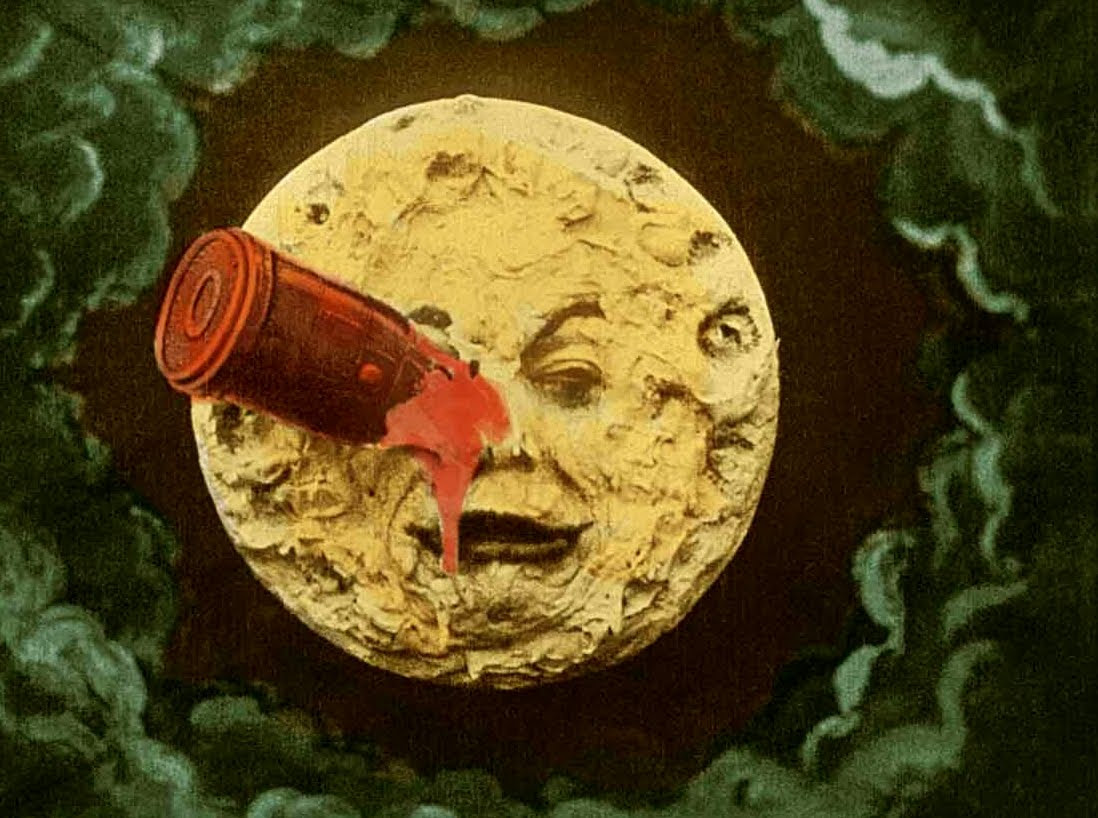
Almost from the time that cinema was first introduced, film makers have been experimenting with colour. Between 1897 and 1912, director George Méliès employed artists at Élisabeth and Berthe Thuilllier’s Parisian colouring lab to hand-tint features such as A Trip To The Moon (1902), The Kingdom of the Fairies (1903) and The Impossible Voyage (1904). The colour versions of these titles would be advertised alongside the black and white originals and audiences charged a higher price to watch them.
Kinemacolour chameleon
British business, The Natural Colour Kinematograph Company, used red and green filters to create the colour palettes, between 1908 and 1915. The company mainly documented real life events and spectacles such as The Funeral of King Edward VII (1910) and Coronation of George V (1911).
The first commercially produced colour film was an eight minute short entitled A Visit To The Seaside (1908), in which audiences could sample the delights of Brighton’s seafront. The World, The Flesh and The Devil (1914) was one of the first colour feature length dramas (this is now considered a lost film but one you might just happen upon if you’re scrolling hopelessly for too long on the ‘recently added’ titles on Amazon Prime – I’ve seen some stuff on there… the horror, the horror…)
The company was liquidated after losing its patent protection in 1914, but it had given the public a thirst for more colour films.

Happy and Glorious
Perhaps the best known name in colour film, and that which defines the golden age of cinema, is Technicolor, which was first introduced in 1916, before being perfected in the 1930s. Technicolor used a black and white film reel which was then transferred onto a red, blue or green filter, using a beam splitting prism, and, from 1924, used a full colour exposure process for a wider colour palette.
Becky Sharp (1935) was the first feature film to use the three strip Technicolor technique, marking a significant landmark in movie history. However, perhaps the best known example from this time is the much loved classic The Wizard Of Oz (1939), where Dorothy Gale (Judy Garland – need I even write this?), dreams of a better life away from her dreary grey farm in Kansas and is transported, by way of a helpful tornado, to a vibrant world over the rainbow in Oz.

Bursting into life
Later films that used the same gimmick include Pleasantville (1998), where Tobey Maguire and Reese Witherspoon become transported into a 1950s black and white sitcom and, when they start shaking things up a bit in the town, start turning everything colour, and Peter Jackson’s masterpiece, They Shall Not Grow Old (2018), where colour, sound and voices have been painstakingly restored, using modern techniques, to expose the true horror of trench warfare in World War I.
A reverse of the black and white into colour can be seen in Mr Jones (2019), a bleak biographical thriller. James Norton plays Gareth Jones, a British journalist who uncovered the shocking truth about Stalin’s Soviet Union and the Holodomor, an imposed famine in Ukraine in which millions died between 1932 and 1933. The film begins in colour but the deeper into Ukraine Gareth journeys, and the more atrocities he witnesses, the more monochrome the film becomes.

A picture tells a thousand words
Black and white film is often used as a narrative device to convey flashbacks and memory.
Casino Royale (2006) used monochrome in its opening flashback scene as a nod to the past films in the franchise, before launching into a different style for the genre and revamping the brand for a new audience.
In Kill Bill: Volume 1 (2003), Uma Thurman’s The Bride has to fight off a rabble of over 40 armed assassins. Quentin Tarantino tones down the visual violence by filming in black and white, similar to the kung fu films of the 1970s, which did similar to get past the sensors.
In contrast, Derek Jarman’s Blue (1993), features a completely saturated blue screen and a narrative of voices from friends, collaborators and Jarman himself talking about daydreams, stories and his daily life as a gay man living with AIDS in 1990s London. Blue was Jarman’s last film as he died in February 1994, and the narrative was later released as a CD.

The thin red line
As a film student, back in the day (this, too, would be shot in sepia) one of my first essays involved analysing the use of colour in The Godfather (1972). The darkness of the interiors indicated shady dealings and the murky world of organised crime and Diane Keaton wore a red dress because (spoiler alert) she was an outsider to the family. If you want more, I suggest you enrol yourself onto a BA Hons programmet
Spielberg’s masterful epic Schindler’s List (1993) is predominantly black and white, apart from the scenes at the beginning and end, where characters observe the Shabbat. The film details how German businessman Oskar Schindler saved over a thousand Jews from perishing in the Holocaust. A key scene involves a three year old girl, wearing a vibrant red coat, who Schindler sees fleetingly in a crowd. He sees her again later on, in more tragic circumstances. This inspires him to take the heroic action that saved so many.
At the other end of the spectrum, Sin City (2005), used similar techniques to depict its comic book origins by using black and white film throughout and colouring only certain objects and wounds, as a way of highlighting their significance.

Plastic pop
Two little-seen indie gems from 2023 employed the use of colour very effectively in different ways. Greta Gerwig’s Barbie transformed the life of the world’s favourite doll onto the big screen in garish, joyous hyper-colour of Barbie Land with a juxtaposition of more muted tones when she got into the real world and found that having cool roller skates and a sunny disposition weren’t Kenough to overthrow the patriarchy.
Christopher Nolan’s Oppenheimer used black and white and colour to depict scenes from different points of view, while the images of the nuclear explosions and their fallout used bright flairs surrounded by the dark (k)night.

And now something a lot more tenuous…
And finally, I am currently enjoying the autobiography Out Of The Corner by Jennifer Grey (you see? It all links!), which I was kindly given for Christmas. I may be the last person to discover that her father is Oscar-winning Joel Grey, who played the creepy Emcee in Cabaret (1972). Anyway, so far it’s a very interesting read about growing up surrounded by Broadway royalty and the perils and pitfalls about trying to make it in the entertainment industry, even with all the connections.
So, those are just some of the many thousands of examples of fabulous cinema colour. Hopefully you will think of your own and see how colour is used on the next film you watch.
I hope that you enjoy The Blue Caftan – wear something bright to cheer everyone up in January!

Stay safe and always try to bring a spot of colour to proceedings. See you at the movies!
Sarah
Information about the Chiltern Film Society can be found HERE