Was the Season to Be Snotty…
One of the lovely things about writing this blog (aside from watching and researching films, before imparting my vast and extensive knowledge onto you, dear readers) is that I get to choose which titles to write about. On a bountiful month at The Elgiva, there can be a selection of two or three features which I can pick from, and form a pithy and irreverent piece, with a few witty quips and asides thrown in for a good measure. (At least, that’s what is intended… Correspondence to the usual email…)
January at The Elgiva seemed to be rich pickings in this regard, with both The Boy and the Heron (2023) and Scrapper (2023) offering much in existential musings and warm-hearted pathos. This was until, horror of horrors, most of my family came down with what seemed to be all the winter bugs over the festive season, starting on Christmas night, and like a fever-dream inspired game of dominoes, vastly outstaying their welcome way into the new year. This series of Unfortunate Events (2004) left me with one option.
The Keeper of the Castle
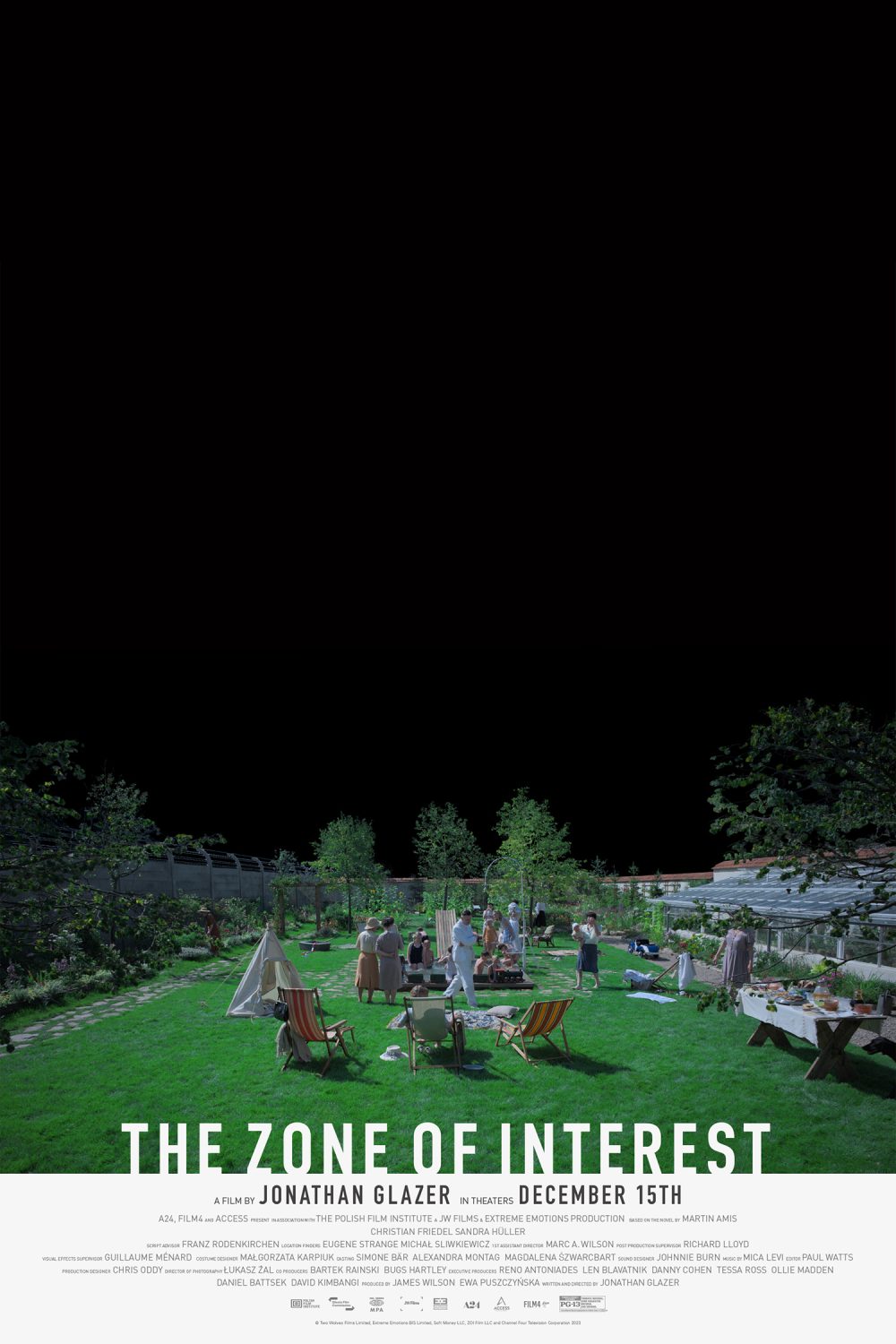
The final film this month, to be screened at The Elgiva on Wednesday January 29th, is the historical drama, The Zone of Interest (2023). And yes, my friends, I will tread very carefully indeed…
Helmed by British director, Jonathan Glazer, and based on the 2014 novel by Martin Amis, The Zone of Interest centres on the Höss family in German occupied Poland in 1943. Rudolf, wife Hedwig, and their children live a seemingly idyllic existence in their extensive country estate, their house adorned with lavish furniture and rugs, framed by a beautiful, well-tended garden.
The family picnic in the countryside, swim in the garden pool and hold extravagant dinner parties. Their maids, silently and extremely carefully serve food and refreshments, while the gardener tends to the roses, with a copious supply of fertilizer for the roses. Rudolf chairs meetings with colleagues in the living room, to discuss, with chilling causal detachment, the latest engineering developments at work, to aid logistics. He brings home fine clothes and make-up for his wife, toys for the children, and takes requests as to what further things that they might like.
The only issues spoiling this idyllic existence are the weeping and screaming, which accompany the sickening sounds of machine gun fire, coming from the other side of the ever-present high brick wall, and the billows of black smoke that loom in the sky, next to an ominous black tower. But if you can live with that, as Hedwig’s mother coos, “You’ve really landed on your feet, girl…”
The most powerful and disturbing aspect of The Zone of Interest is the attention that is given to what is not seen. Viewer’s previous knowledge of the atrocities of the Holocaust and their own vivid imaginations paint dark images in the mind’s personal movie theatre. This element, along with the fact that both the audience and the family know what is going on behind the wall, and those with any powers to stop it are instead choosing to exacerbate the horrors for both national and personal gains, makes the film an extremely unsettling but very essential watch.
The audience may well be left thinking about it for days afterwards – I personally had to watch a couple of episodes of broad US comedy Brooklyn 99, to try to calm myself down, just to get to sleep.
The Zone of Interest has been nominated for many international awards, those it won include Best International Feature and Best Sound at the Academy Awards, Best Sound at the BAFTAs and the Grand Prix and Soundtrack Award at Cannes. Although The Zone of Interest discusses the violence and horrific cruelty of the events in Auschwitz, it also raises the wider question of how much will an individual turn a blind eye to the current barbarity in the world, and how does one justify these decisions?

The Mind’s Eye
The conceit of violence taking place off screen, leaving the audience to fill in the blanks on the timeline, is a strong way that filmmakers can direct the narrative.
Disney’s Bambi (1942) used a single gunshot sound to signify that the fawn’s mother had been killed, achieving the hat trick of traumatising its fragile audience, creating future generations of flexitarians and teaching children to become very suspicious of animated family films featuring talking animals.
The Coen Brothers’ No Country for Old Men (2007) cuts away from the full extent of most of the murders committed by hitman Anton Chigurh (played by Javier Bardem), and only the aftermath of the film’s pivotal showdown. It is often regarded as one of the team’s best films, although the deliberate omission in the narrative payoff may leave some viewers feeling short changed. (I’ve also only seen this one once…)
Dark drama, Berberian Sound Studio (2012) sees sound engineer, Gilderoy, (Toby Jones), travel to Italy to add auditory effects to a low-budget horror in a grimy, shadowy postproduction house. Armed with a selection of vegetables, kitchen utensils and (questionably), an overactive imagination, Gilderoy proceeds with his assignment while falling deeper into the mucky depths of what is real and what has been strategically implied on screen. This is not one for the squeamish, some of the sound effects made me feel quite sick, and despite being made over 12 years ago, I’ve haven’t been able to view Toby ‘national treasure’ Jones in the same way since, even in BBC’s The Detectorists. That, I guess, is the magic of cinema… (and marrows).

History will be the Judge
Due to the heavy weight and significance of the subject matter, a great many films have been made which discuss the Holocaust.
The Boy in the Striped Pyjamas (2008) is another title where the exact nature of the drama is slowly revealed. It tells the story of young Bruno (Asa Butterfield), whose father is an SS officer. Bruno and his family live in a big house, with what looks like a farm at the end of the garden, but he and his sister are forbidden to go and explore. One day, curiosity gets the better of Bruno, and on taking a walk through the woods near his house, he makes a new friend, Shmuel (Jack Scanlon), who lives with his family in the compound and wears the clothing of the film’s title. Bruno starts meeting Shmuel regularly and bringing him food, neither boy is aware of the dangers that these innocent actions may have for either child.
Schindler’s List (1993) is Steven Spielberg’s epic, filmed in mainly black and white, and telling the story of Oskar Schindler (Liam Neeson), a German business owner who saved over a thousand Polish-Jewish refugees from the Holocaust by employing them at his factory. Although Spielberg had previously directed dramas, Schindler’s List is regarded as his masterpiece, receiving seven Academy Awards, and is frequently cited as an example of exemplary film making.
There are many other acclaimed titles that could be mentioned, including Sophie’s Choice (1982), The Reader (2008), The Zookeeper’s Wife (2017), Europa Europa (1990), Conspiracy (2001), Au Revoir Les Enfants (1987) and The Pianist (2003).

Life is Beautiful (1997) is a bittersweet Italian drama, directed by and starring Roberto Benigni. Jewish bookshop owner Guido Orefice (Benigni) lives with his wife Dora (Nicoletta Braschi) and young son Giosue (Giorgio Cantarini) in occupied Northern Italy in 1944. The family are seized and sent to a concentration camp where Dora is separated from her husband and son and put in the women’s prison. To help his son become less afraid of their dreadful circumstances, Guido makes up a game with Giosue, creating a series of challenges for him, with the promise of a prize of a military tank, upon completion of all the tasks.
Life is Beautiful won the Grand Prix at Cannes and three Academy Awards, including Best Foreign Language film. It was an international success with audiences, however, some critics found that it made light of its subject matter and that realistically, Guido would have been unable to act this way in a death camp. It is then, probably, best to view Life if Beautiful as a fable, and a way to install hope in the human spirit, as it shows the lengths that a person will go to to protect their loved ones from the evils of the world, even in the face of dire adversity.
We can’t promise that you’ll enjoy The Zone of Interest, but we hope it will give you lots to think about and have some meaningful conversations. The CFS committee is always around on CFS film nights to have a chat about what has been screened.
And finally…
This month we said goodbye to the Godfather of the Avant Guard, director David Lynch. Known for his often-surrealist works, Lynch became a cult favourite with his first film, Eraserhead, in 1977. The Elephant Man (1980) and Blue Velvet (1986) followed, as did the original Dune (1984) and Wild At Heart (1990).

Lynch’s dream-like narratives, where events don’t follow a linear pattern, continued in Lost Highway (1997) (where everyone on my film course chorused a “Huh?” at the same pivotal moment), Mullholland Drive (2001), and the groundbreaking television series and then film (which answered no questions) Twin Peaks. Always pushing boundaries, and never worrying about fitting into the mainstream, Lynch carved his own niche, and cinema is richer for it.
Those wanting something a bit more accessible could always opt for The Straight Story (1999), a visually sumptuous drama about one man’s journey across the American Midwest… on a ride-on lawn mower.

Rest easy in the land of dreams, Mr Lynch. And thank you.
We look forward to welcoming you on 29th January and we hope you’re enjoying the lighter evenings.

Be kind and look after each other, and we’ll see you at the movies.
Sarah
Information about the Chiltern Film Society can be found HERE